
Solid wood, veneer or lacquer: which material should you choose for your cabinets?
Choose solid wood for frame-and-panel doors (shaker or raised panel) that can be sanded and refinished, veneer for real-wood slab doors that stay flat and cost less, and lacquer for a smooth solid colour, matte or glossy, that wipes clean. Well built, all three last a long time: the right choice depends mostly on the door style, how your kitchen is used and your budget.
Last updated :
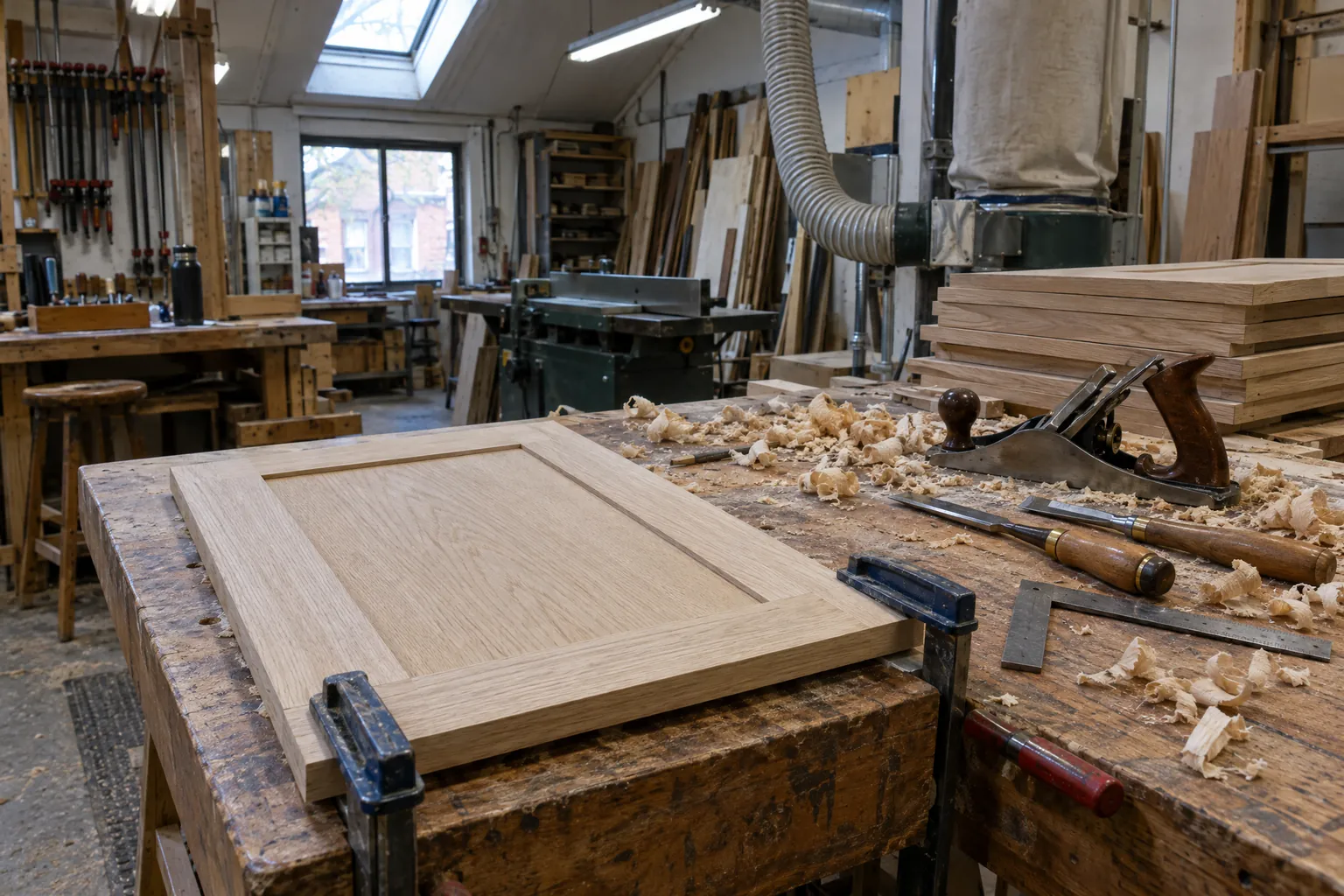
In short: solid wood brings the warmth of real wood and can be repaired, but it moves with humidity; veneer gives the look of real wood on a stable panel for less; lacquer allows any colour on a smooth surface, but an impact can chip it. Many kitchens combine all three, for example lacquered fronts and a wood island.
What is the difference between solid wood, veneer and lacquer?
Solid wood: solid pieces of lumber (white oak, walnut, maple, ash), usually joined as a frame around a panel. The grain is natural and every door is unique.
Veneer: a thin sheet of real wood glued onto a stable panel of MDF or plywood. It gives the look of the chosen species and lets the grain run continuously from one door to the next, the signature of high-end kitchens.
Lacquer: an opaque finish sprayed in several coats over an MDF panel. It gives a perfectly even colour, from matte to high gloss.
In all three cases, it is the fronts (doors and drawer fronts) that change; the boxes are most often high-density melamine or plywood.
How do solid wood, veneer and lacquer compare?
| Criterion | Solid wood | Veneer | Lacquer |
|---|---|---|---|
| Look | Natural grain, every door unique | Real wood, continuous grain possible | Solid colour, matte or glossy |
| Door styles | Shaker, raised panel | Mostly slab doors | Slab, shaker, grooved |
| Humidity | Moves with the seasons | Very stable | Very stable |
| Impacts | Marks can be sanded out | Good resistance, edges more fragile | Can chip |
| Repair | Sanding and refinishing | Light touch-ups (thin layer) | Touch-up by a professional |
| Relative price | Among the highest | Mid-range | Among the highest |
From most affordable to most expensive, the usual order is: thermofoil, high-density melamine, veneer, then solid wood or lacquer. Care is the same for all three: a soft damp cloth, mild soap, never anything abrasive.
Is solid wood always the best choice?
Not always. Wood is a living material: between the dry air of heated Montreal winters and humid summers, it swells and shrinks a little with the seasons. That is why solid-wood doors are built as a frame with a panel that can move freely, and why large slab doors are almost always veneer: in solid wood, they could warp.
Solid wood really shines for shaker or raised-panel doors, an island that serves as the centrepiece, open shelving or millwork that has to match an older home. Its big advantage: years later, it can be stripped, stained a new colour and refinished.
Four species come up most often: white oak, with a pronounced grain and great durability; walnut, brown and warm; maple, with a fine, even grain and a very hard surface; and ash, with a bold grain but paler than oak. In our Dorval workshop we work them in solid wood or veneer, with low-VOC varnishes, oils and stains.
When does veneer make more sense?
For a contemporary kitchen with wood slab doors, veneer is the logical choice: it stays flat even on tall doors or on the panels that hide a fridge, and the grain can flow across a whole wall of cabinets. It also costs less than a solid-wood door in the same species.
Its limit: the wood layer is thin. It can be touched up and re-varnished, but not sanded again and again. Good-quality veneer can still be stripped with care; we always test one door before recommending it.
Is lacquer tough enough for a kitchen?
Yes, when it is properly applied. Its smooth, sealed surface wipes clean in seconds, and it comes in any colour, from white to forest green. A matte or satin finish hides fingerprints better than high gloss.
Its weak spot is impact: a pot or a chair hitting an edge can leave a chip. It can be repaired, but an invisible touch-up takes a professional who can match both the colour and the sheen.
What about thermofoil or melamine?
These are the budget options. Thermofoil is a PVC film moulded over an MDF panel: affordable and easy to clean, but it dislikes heat near the oven or toaster and is hard to repair. High-density melamine is very tough and easy to maintain, especially for boxes and simple slab doors. Both work well in a laundry room, a basement or the kitchen of a rental unit.
How do you choose for your kitchen?
- You love shaker doors and wood grain: solid wood.
- A contemporary kitchen with wood slab doors: veneer with continuous grain.
- A bold colour and easy cleaning: matte or satin lacquer.
- Kids, pets, chairs bumping the lower cabinets: wood or veneer, more forgiving than glossy lacquer.
- A tight budget: veneer or lacquered fronts with solid wood saved for the island, or refacing if the boxes are sound.
- A plex with original woodwork: solid wood stained to match the mouldings.
Nothing beats real samples: we bring them to the visit, and you can see the Dorval workshop by appointment. For prices, see our guide to custom kitchen cabinet prices and our custom cabinetry page, or ask for a free quote.